American Sign Language vs Indian Sign Language: Key Differences
While both share a one-handed alphabet, ASL and ISL differ in cultural context, grammar, and regional vocabulary. Discover how these two dominant systems compare.
Editorial Team
Direct Answer
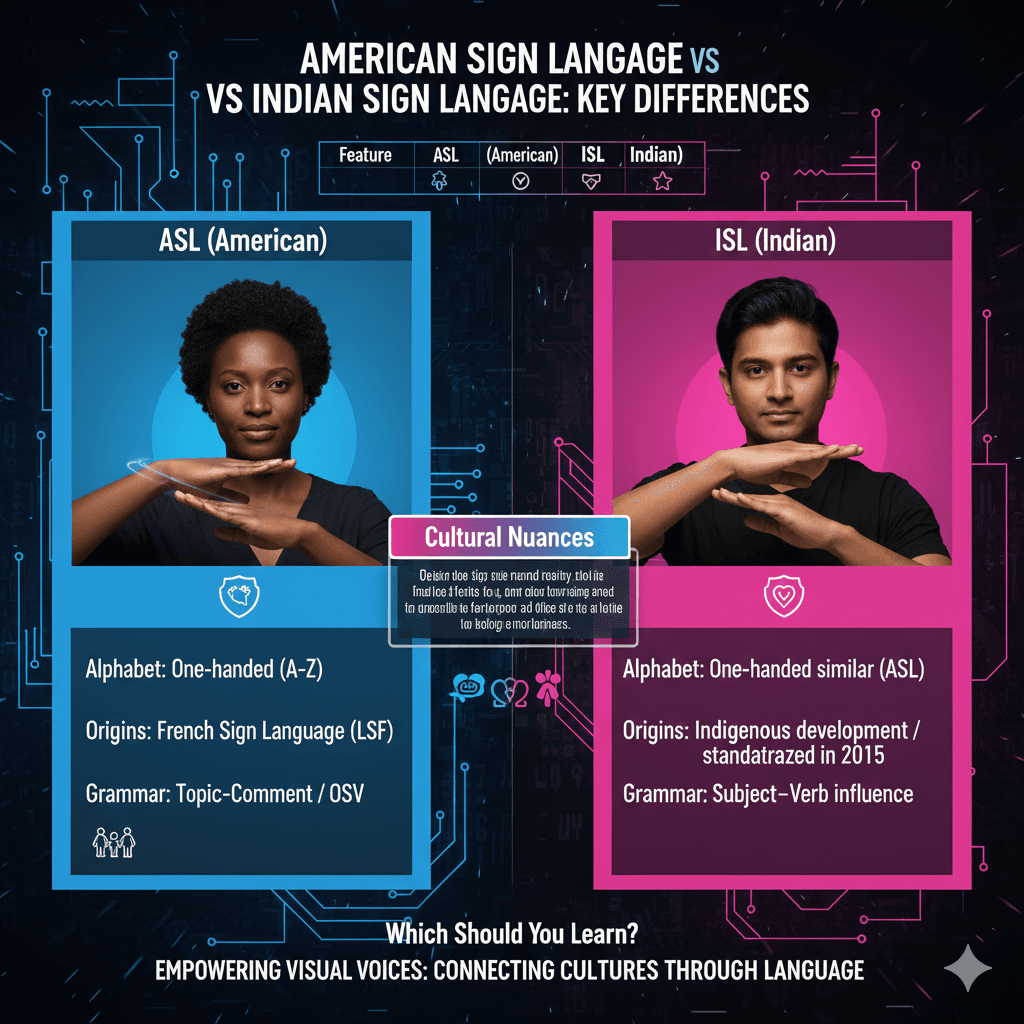
American Sign Language (ASL) and Indian Sign Language (ISL) are both dominant visual languages, but they serve very different cultural contexts. While both use a one-handed manual alphabet (unlike the two-handed BSL), they are not mutually intelligible. ASL has deep roots in French Sign Language, while ISL has developed its own standardized lexicon through the Indian Sign Language Research and Training Centre (ISLRTC).
Comparison of Key Features
| Feature | ASL (American) | ISL (Indian) |
|---|---|---|
| Alphabet | One-handed (A-Z) | One-handed (similar to ASL) |
| Origins | French Sign Language (LSF) | Indigenous development / standardized in 2015 |
| Grammar | Topic-Comment / OSV | Subject-Object-Verb influence |
| Numbering | 1-5 (palm in/out) | Regional variations common |
Historical Context
ASL was standardized in the early 19th century in Hartford, Connecticut. ISL, by contrast, existed as a rich collection of regional dialects for centuries before a unified, standardized version was formally recognized and promoted by the Indian government in the last decade. This makes ISL a rapidly growing and evolving academic language today.
Cultural Nuances
ISL incorporates many signs that reflect Indian culture, family structures, and religious practices that do not exist in ASL. Conversely, ASL includes idiomatic expressions specific to North American culture. For example, the sign for 'family' or 'marriage' differs significantly due to the different societal norms in each region.
Which Should You Learn?
If you are in India, ISL is the standard for education and government services. If you are in North America, ASL is the primary language. Due to the 2026 'Digital India' push, ISL resources are now more accessible online than ever before.
Link: Sign language basics. Reference: ISLRTC Official Portal