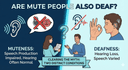
Is Sign Language Universal? The Truth Explained
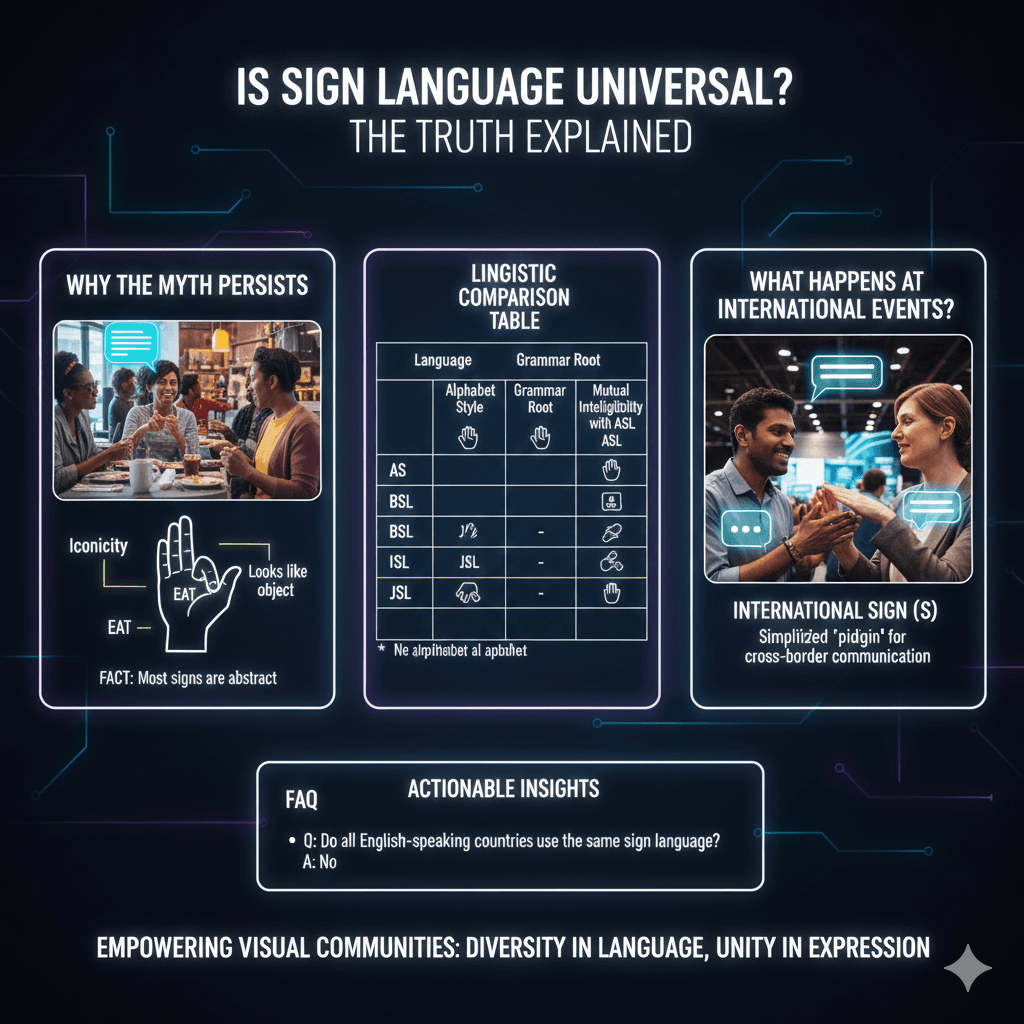
No, sign language is not universal. Each country has distinct languages with different grammar and vocabulary, making ASL and BSL completely different.
Editorial Team
Direct Answer
The most common misconception about sign language is that it is universal. It is not. Just as a person speaking Hindi cannot naturally understand someone speaking German, a user of Indian Sign Language (ISL) cannot naturally understand someone using American Sign Language (ASL). They are distinct languages with different vocabularies, handshapes, and grammatical rules.
Why the Myth Persists
The myth likely stems from 'iconicity', the fact that some signs look like the object they represent (e.g., the sign for 'eat' often involves a hand-to-mouth motion). However, iconicity only accounts for a small fraction of any sign language. Most signs are abstract and arbitrary, requiring formal study to understand.
Linguistic Comparison Table
| Language | Alphabet Style | Grammar Root | Mutual Intelligibility with ASL |
|---|---|---|---|
| ASL (USA) | One-handed | French (LSF) | 100% |
| BSL (UK) | Two-handed | British | < 30% |
| ISL (India) | One-handed* | Indigenous/French influence | Partial similarities |
| JSL (Japan) | One-handed | Japanese | Near 0% |
*Note: ISL primarily uses a one-handed alphabet similar to ASL, whereas BSL uses a two-handed system.
What Happens at International Events?
When Deaf people from different countries meet, they often use International Sign (IS). IS relies more heavily on visual gesturing and common 'loan signs' to bridge the gap between different national languages. It is a tool for communication, not a replacement for native sign languages.
FAQs
- Do all English-speaking countries use the same sign language? No. The US, UK, and Australia all have their own unique sign languages.
Link: ASL vs ISL Differences. Reference: British Deaf News